Accounts of local maritime history, which often include references to dramatic shipwrecks and lost treasure can captivate our imagination. The tragic loss of human life, on the other hand can become lost to history unless it is clearly documented. And that is what this column aims to do.
Since the 17th century, as exploration and settlement of Delaware grew, the area yet to be named became an unwitting stage for shipping disasters and dramatic rescues. Lewes in particular became a site where what was left from lost vessels ended ashore. Gruesomely, it sometimes included the bodies of unidentified victims lost by storms or by accidents. Historic accounts even hint that many local shipwrecks were caused by piracy.
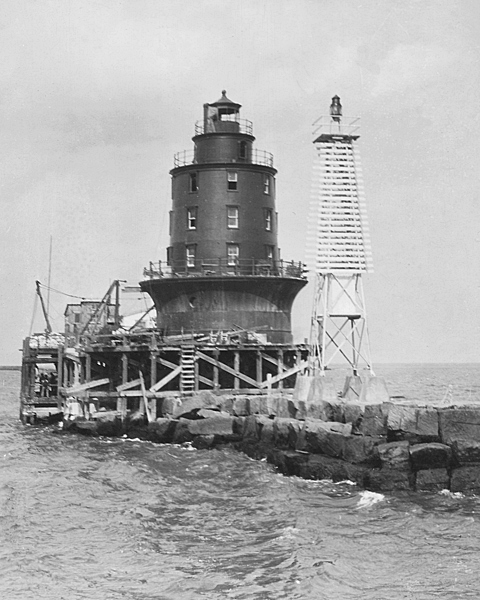
Forget while you read this, the lost treasure that centuries later still has beachcombers looking down at their feet. Chancing upon sea glass or remnants of a broken sailing mast is equivalent to winning the relic lottery to some who continue to ponder or romanticize what actually happened at sea, when passengers and sailors were so close to Lewes’s Harbor of Refuge?
What happened to the victims of shipwrecks and their remains? It turns out, many but not all have a final resting place, unmarked but in our midst. Others, as they say, are forever lost at sea.
Those of us who are relatively new to Sussex County may be surprised and fascinated by the fact that there are hundreds of anonymous sailors and other shipwreck victims buried under the asphalt of what is now the parking lot of the Lewes ferry terminal.
For hundreds of years now, given documented Lewes and Rehoboth history, catastrophic losses at sea plagued Delaware’s Atlantic Ocean and Delaware Bay coastline.
Bodies or lesser remains of the dead from shipwrecks off shore occasionally washed onto local beaches where, respectfully, they were given the best burial possible under the sad circumstances.
The sandy, unoccupied area between Lewes and Cape Henlopen became a collective, respected burial ground for the unidentifiable. The majority of the remains, according to most accounts I’ve researched were sailors, but there is no doubt other victims have included men, women and children in the crosshairs of the unpredictable Atlantic Ocean and Delaware Bay.
The prevalence of ship disasters along the East Coast – not just Lewes – was so severe as the population grew, that it became the impetus for formation of the United States Lifesaving Service in 1848 (eventually becoming the US Coast Guard).
Lewes was once a major eastern port for a fledgling nation. Its bay location was is aptly named “Harbor of Refuge,” a symbolic moniker we still retain. Ships seeking safety on their way to major ports once filled the harbor, particularly in foul weather. Unfortunately, not all ships made it to safety in the harbor (which itself, by the way, was not always safe from Nor’easters.
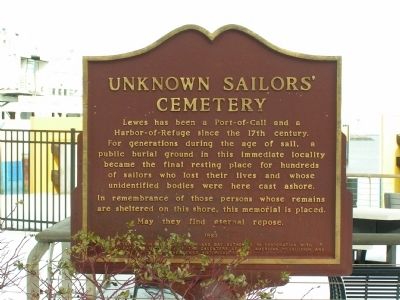
At what is now the Lewes ferry terminal, the “Unknown Sailors Graveyard,” was the final resting place for hundreds of souls lost at sea, whose remains washed up on Lewes’s and Cape Henlopen’s beaches. They were respectfully buried in what was once an undeveloped swath of sandy waterfront.
Remains that were not able to be identified were excluded from burial at organized cemeteries. Local parishes with their own cemeteries did not not accept remains of people without proof of origin or religious faith. Therefore, graves were on municipal grounds. There were no individual markers (or may have been lost to years of harsh elements), but human remains were treated with respect and given a proper burial, however rudimentary it may sound now.
Estimates of remains at the Lewes terminal vary considerably, from at least 800 to more than 3,000. The majority of burials at the site are documented as sailors, hence the “Unknown Sailors Cemetery” title implies. But historians agree: there is no way to accurately document the number of people whose lives were lost just off our coast.
To add to the mystery of this sacred area, artifacts such as pottery shards were uncovered during construction of the ferry property in the early 1960s while making way for the new ferry terminal, opened in 1964. It has led archaeologists to suggest the area could conceivably be a Native American burial ground.
In what many felt was an inadequate gesture, a memorial marker for the “sailors” was finally erected in 1983 near the ferry terminal complex. The marker reads in part that it is dedicated to “hundreds of sailors who lost their lives and whose unidentified bodies were here cast ashore.”
Burial remains of the Unknown Sailors Graveyard, according to Delaware code established in 1953 (Title 7) ironically indicates exactly where the site is, and that it was supposed to be maintained by the state’s Society of the Preservation of Antiquities. It is unclear how that code was overlooked during construction of the terminal, despite public protest about disturbing the dignity and final resting place of hundreds.
Employees and travelers alike still talk about the theory that even today, the ferry terminal is haunted. Tales of mischief and ghostly figures and cigar odor permeating the ladies’ rest room still pique the interest of believers. There have even been “paranormal tours” after hours, with lights out and electromagnetic detection devices.
After looking further into the story of Unknown Sailors Cemetery, I chanced upon existence of several unmarked graves in Sussex County, Delaware. There are more in our midst worthy of sharing with readers. Meanwhile, next time you visit the ferry terminal, be sure to visit the historical marker that modestly memorializes countless lives lost.
By Bridget FitzPatrick
Writer’s note: Many thanks to a gentleman named Paul Kaminsky, a Lewes native and Cape alumnus now residing in Plano, Texas. Paul’s commentary in a recent edition of the Cape Gazette sparked Delaware Retiree’s interest in this subject, only to discover there are additional unmarked burial grounds in our midst deserving our respect. Thank you, Paul.

 Skip to content