
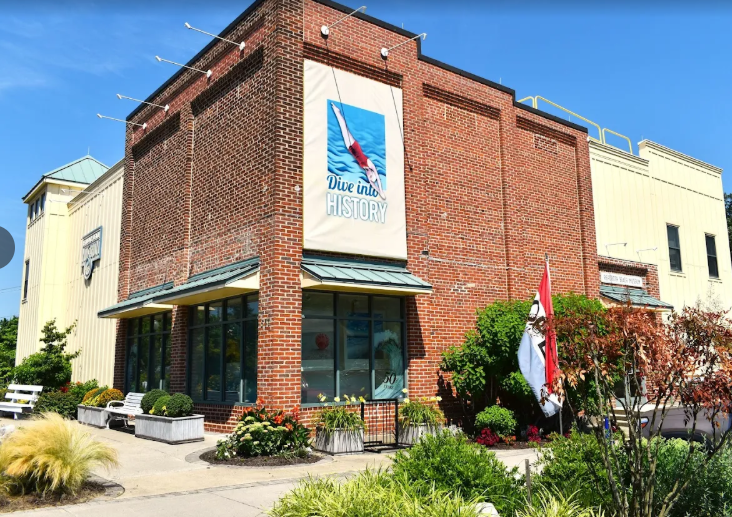
“Small but Mighty” may be the perfect way to describe two local museums – the Rehoboth Beach Museum located near the lighthouse adorned traffic roundabout at the entrance into town and the Lewes History Museum, also known as the Margaret H. Rollins Community Center, located on Adams Avenue right next to the current Lewes Library. In fact, the Lewes History Museum was the Lewes Library for 30-year until the newer building opened in 2016. The museum is currently closed for renovations and will re-open in May 2026. The facility is an arm of the Lewes Historical Society, now called Historic Lewes.
The Rehoboth Beach Museum is easy to spot because it now is “home” to one of the town’s most iconic visuals – the bright orange Dolly’s sign that adorns the west side of the building. It towers over the Rehoboth-Lewes Canal that runs right below it.
The Museum offers a timeline on how Rehoboth evolved from a religious retreat to what is now known as “the Nation’s Summer Capital”. Some of the information may surprise you. How many recall that Rehoboth’s roots lie with the Nanticoke tribe of Native Americans or that it first European settlers were Dutch?
Do many people know that Rehoboth is a Hebrew word meaning Open Space?
From 1873 – 1899, Rehoboth was a religious seaside resort. The Rehoboth Beach Camp Meeting Association of the Methodist Episcopal Church was formed between 1871 and 1873. The name Rehoboth stems from a passage in Genesis in which Isaac found a well in a place called Rehoboth and declared “The Lord has Made a Place for us”. The religious community is Rehoboth still thrives from those initial efforts with the All-Saints Episcopal Church, Epworth Methodist Episcopal Church, and St Agnes By-the-Sea, among others.
The last camp meeting was held I 181 and now another camp featured at the museum plays a significant role in the economy and community aspects of Rehoboth – CAMP Rehoboth. CAMP stands for Creating a More Positive Rehoboth. It was founded in 1991 by the late Steve Elkins and artist Murray Archibald to address discrimination against the LGBTQ community. The vision was right in line with that Genesis reference. It’s mission states that “we seek to promote cooperation and understanding among all people as we work to build a safer and inclusive community with room for all”.
There is no more relative aspect of Rehoboth’s evolution than the role of the African American community. Currently, the museum is featuring a special exhibit called “Celebrating African American Rehoboth 1690 – 1960”. The exhibit runs until May and it is located on the second floor of the museum. Key features explain the role of the Faith United Methodist Church, the so-called 400 Social Club, the American Legion State Post and, of course, the legacy of West Rehoboth. A companion display covers the period from 1968 to the present.
The museum also celebrates the role of the Cape Henlopen Lighthouse, the lore of shipwrecks, the dedication of Rehoboth’s lifeguard contingent, the growth of Rehoboth’s culinary scene and the town’s “fun factor” for families highlighting Rehoboth’s popular beach and arcades along the boardwalk. Those familiar with the town will appreciate old signs rom long-gone establishments like La La Land and the Royal Treat ice cream parlor and possibly the Carleton the Bear” costume.
The museum offers some special treats for children with a cozy play/learning area plus a special “Kids Guide to the Museum” and a fun Scavenger Hunt booklet. AND if you want to get involved, their big fundraiser is a great way to jump in: The Beach Ball!
Locals and vacationers alike will learn a lot a lot by visiting the museum.
By Mary Jo Tarallo, Resident Journalist
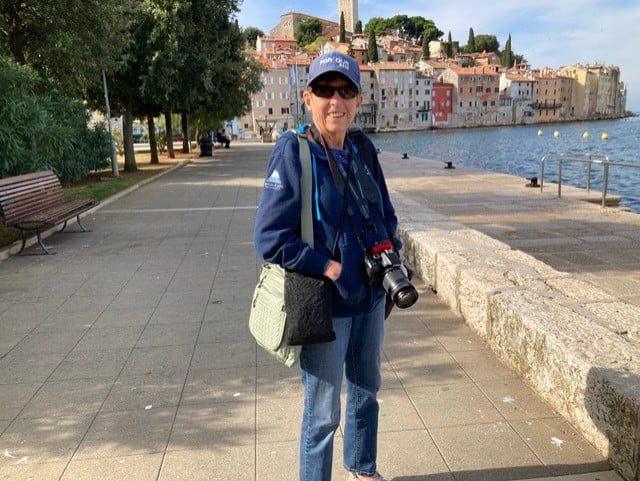
Mary Jo Tarallo spent much of her career in public relations with various non-profits and spent 40 years involved with the ski industry as a journalist, public relations director for a national trade association and as executive director of the Learn to Ski and Snowboard initiative. Prior to her ski industry involvement she worked for the Maryland International Center in Baltimore and United Way of Central Maryland. She won a Gold Award for TV programming for a United Way simulcast that starred Oprah Winfrey. She has been cited for her work by numerous organizations. Mary Jo grew up in Baltimore, attended the University of Maryland and Towson University, lived in Washington, DC for 21 years and has been a full time resident of Rehoboth Beach and Milton since May 2019.

 Skip to content