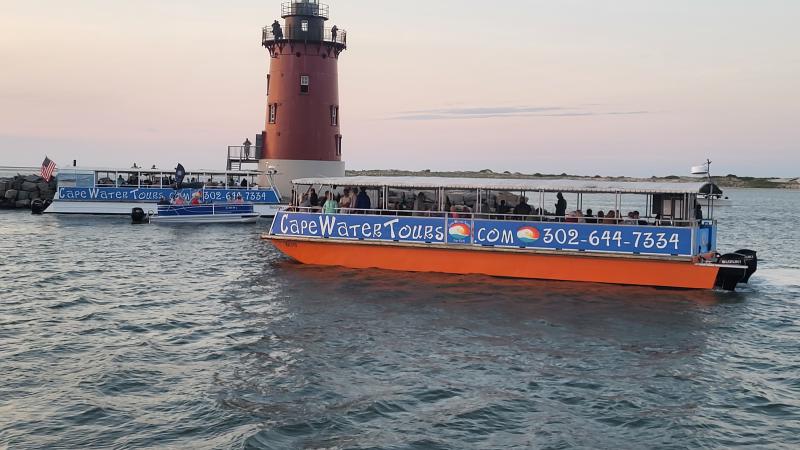
I recently enjoyed a dolphin watch excursion by Cape Water Tours. No one on board was disappointed, despite it being the hottest day of the summer thus far. One might think that the world slows down when it’s uncomfortably hot, but don’t tell the dolphins, who were surprisingly abundant and active.
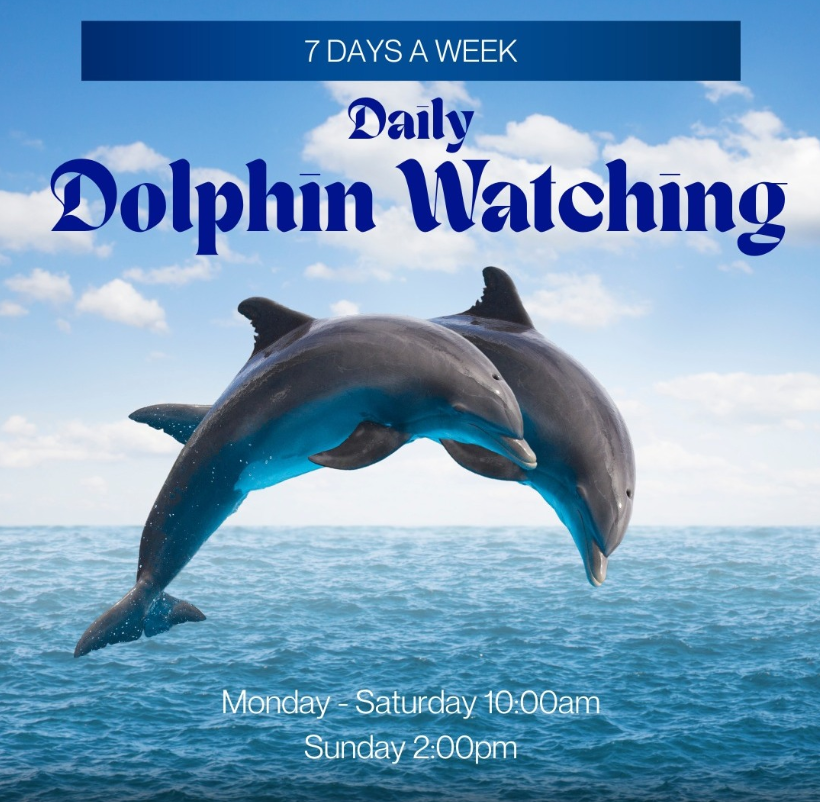
The tour, which departs from the Lewes ferry terminal and lasts about 90 minutes, was narrated by staff from MERR (Marine Education, Rescue and Rehabilitation). Rob, the director of educational programs for MERR made the tour fascinating. And he was especially adept at engaging the children “mini marine biologists.”
We witnessed a surprising number of dolphin “pods,” or schools, rolling gracefully through the waters of both the Delaware Bay and Atlantic, just off the coast of Cape Henlopen. Likely, as Rob explained, they were actively feeding (they require massive amounts of sustenance every day). While they look pretty and graceful, they are actually coming up for air while on an active hunt.
Despite their constant quest for food, dolphins are also known to play and often swim alongside boats to socialize – as long as they do not feel threatened. As Rob described in detail, these highly intelligent marine mammals adapt to their surroundings, and even exhibit empathy. For example, dolphins have been known to nudge or even rescue other marine animals, such as whales, when they are in danger. Rob could go on about the details of dolphins’ intelligence, but to put it simply, dolphins in many ways are smarter than most of us humans.
There is a wealth of information that was provided on the MERR tour, including dolphins’ breeding, habitat and current threats to their environment. A good portion of the tour was dedicated to explaining MERR’s role in marine life conservation and rehabilitation.
MERR rescues injured marine animals, and in some circumstances conducts necropsy (the diagnosis of the animal’s cause of death), vital to their research. MERR has many feel good stories about saving marine life, but unfortunately, they also have to deal with – and study – the cause of a stranded animal’s tragic death.
Dolphins are a big part of MERR’s research and the tour we were on, but there are several other Delaware species that MERR studies and rescues. Other marine animals are also in perpetual danger from human activity, from environmental threats to marine vessel strikes. Terrapins, whales and seals, for example, have suffered unnatural injuries and worse.
During the tour, another staffer from MERR presented more wonders about the marine life in our midst, and the importance of stewardship. While we were still oohing and ahhhing with every dolphin sighted, Rob’s designated “junior marine biologists” were put to work. They walked through the boat on two levels with samples of a turtle’s carapace (shell), a skull of a dolphin, a whale’s “tooth” that really isn’t, and a sample rib from a seal.
The other marine naturalist then took over the presentation to describe the unfortunate hazards our local marine life face.
Sea turtles, for example, are threatened and are endangered species. They are at high risk for vessel strikes (a collision with a vessel’s propeller) as they come to the surface to breathe, sleep or bask in warm waters. MERR, for example recently attempted to rescue a sea turtle whose carapace (outer shell) was severed by a boat propeller. Chances are the operator either did not notice the collision, or worse, did not report it.
The poor sea turtle did not survive.
Whales, of which there are many within our coast line are also susceptible to vessel strikes and serious or fatal injury. MERR responds to strandings and reports of injured animals, and often needs to employ the help of aquariums in the region equipped to deal with such veterinary emergencies.
MERR often rescues seals that are abundant in our waters. Humans have unwittingly put seals at risk, especially young pups. If speeding vessels frighten a mother seal, she may abandon her pup, and when separated is now vulnerable to attack. Entanglement in fishing lines is a common cause for MERR’s rescue efforts of seals and other marine animals.
Even balloons are a manmade threat to marine life when an animal inadvertently confuses it for food. Entanglement in fishing nets is also a common issue MERR encounters.
All of these statistics are not intended to frighten readers; rather to create awareness and preemptive action. For example, MERR strongly suggests anyone who owns (or knows someone who owns) a boat to install a propellor cover to prevent serious injury if there is a vessel strike with a marine animal. The relatively low cost (between around $200 to $400 depending on the boat size) may save countless precious marine lives, including orphans whose survival depends upon their parents.
There are plenty of other ways in which we can all help MERR’s mission, from volunteering to adopting a dolphin, and even submitting photos of your own marine encounters to MERR to enhance their own research. Sometimes, as our tour guide Rob explained, photos submitted to MERR by casual observers can be essential for their research, such as their annual dolphin count.
Amazingly, MERR biologists can identify specific dolphins by name, based on their collective, repetitive observations.
There is a QR code on MERR’s website for you to upload any photos – even if it’s just a dorsal fin, which helps to track population, migratory patterns and the health of our local marine ecosystem.
A portion of the proceeds from Cape Water Tours’ dolphin tours is donated to MERR as a gesture of support for the Cape region’s precious marine life. There are ways that you, too, can support MERR’s ongoing research and conservation efforts.
Consider adopting a dolphin for a month, a year, or even a lifetime. MERR’s Adopt a Dolphin program makes a great gift idea (think birthday gift for your grandchild).
Most importantly, PLEASE REPORT ANY STRANDED MARINE ANIMAL: MERR EMERGENCY REPORTING
Here are a few helpful links.
# # #
By Bridget FitzPatrick

 Skip to content