As we get older, staying active becomes about more than simply exercising for weight loss or appearance. Maintaining strength, mobility and balance can play an important role in helping adults continue to do the everyday activities they value—from climbing stairs and carrying groceries to traveling, playing with grandchildren and maintaining independence.
The challenge is that traditional approaches to fitness don’t always fit the realities of adult life.
Long workouts can be difficult to fit into a busy schedule. Crowded gyms can feel intimidating or inconvenient. And for people who have experienced back, shoulder, joint or other physical limitations, conventional strength-training routines may not always feel like the right approach.
A different model is gaining attention: shorter, highly focused strength workouts that are personalized to the individual.
Why Strength Matters as We Age
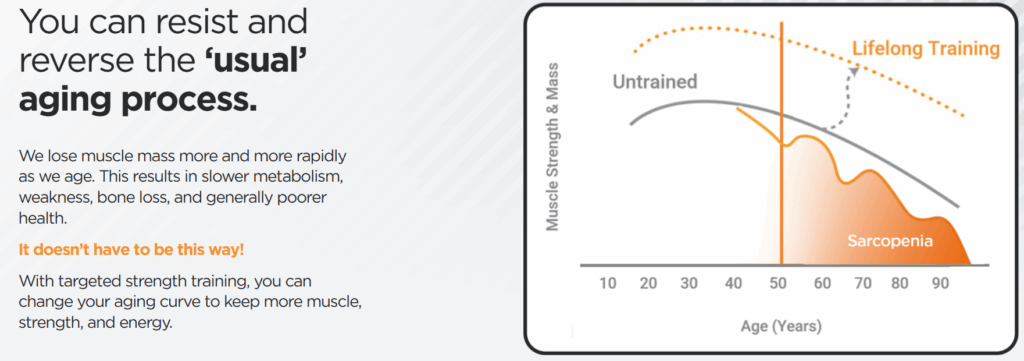
Muscle strength and physical capacity naturally change with age. Without regular activity, adults can gradually lose muscle mass and strength, while balance, mobility and flexibility may also decline.
Those changes can affect much more than athletic performance.
Strength supports many of the movements people perform every day:
- Getting up from a chair
- Climbing stairs
- Carrying groceries
- Lifting and carrying luggage
- Getting in and out of a car
- Maintaining stability while walking
- Performing household tasks
- Participating in recreational activities
Maintaining physical strength can therefore be viewed as part of maintaining function and independence.
The goal doesn’t have to be lifting the heaviest weight in the gym. For many adults, the more meaningful goal is having the physical capacity to continue doing the things they enjoy.
Strength Training Doesn’t Have to Mean Spending Hours at the Gym
One of the biggest barriers to exercise is time.
Many people understand that strength training is beneficial but struggle to consistently dedicate an hour—or more—to a workout. That can lead to an all-or-nothing mindset: if there isn’t enough time for a traditional gym workout, it’s easy to skip exercise altogether.
A time-efficient approach takes a different perspective.
Instead of focusing on how long someone spends exercising, the emphasis is on making the available time purposeful.
With a properly designed strength-training program, approximately 20 minutes of focused exercise, performed consistently twice a week, can provide a manageable starting point for adults who want to incorporate strength training into their routines.
The key is not simply doing less exercise. It’s making the exercise that is performed focused, structured and appropriate for the individual.
Personalization Can Make Strength Training More Approachable
Everyone has different levels of strength, mobility, experience and physical capability.
Two people performing the same exercise may not need—or be able to safely handle—the same amount of resistance or the same range of motion.
That’s why individualized training can be particularly useful for adults who are new to strength training, returning after time away from exercise or looking for an alternative to a traditional gym environment.
Technology can also play a role.
Computerized strength-training systems can measure performance during an exercise and help determine an appropriate level of resistance. Rather than assuming that the same resistance is appropriate for everyone, an individualized system can account for differences in strength and performance.
The underlying concept is simple:
The exercise should adapt to the person—not the person to a predetermined workout.
Coaching Still Matters
Technology is only one piece of the equation.
Having a knowledgeable coach involved can provide another layer of personalization and accountability. A coach can help explain exercises, monitor technique, make adjustments and help an individual stay within appropriate training parameters.
For someone who isn’t comfortable navigating a traditional weight room, this can remove some of the uncertainty associated with getting started.
A private, appointment-based environment can also eliminate some common obstacles, such as waiting for equipment, trying to figure out which exercises to perform or feeling uncomfortable in a crowded gym.
Strength Is Only Part of the Picture
Healthy aging isn’t just about muscle strength.
Mobility, flexibility and balance are also important components of maintaining physical capability.
For that reason, a well-rounded approach to fitness can incorporate activities that support:
- Strength — helping maintain the ability to lift, carry, push and pull
- Mobility — supporting comfortable movement through everyday activities
- Flexibility — maintaining useful movement throughout the body
- Balance — supporting stability and confidence during movement
- Consistency — establishing an exercise routine that can realistically be maintained
Nutrition and other lifestyle habits can also contribute to overall health and physical well-being.
The objective isn’t necessarily to pursue an extreme fitness routine. It’s to build habits that support the ability to remain active and engaged in everyday life.
What Does “Functional Fitness” Really Mean?
Functional fitness is ultimately about the connection between exercise and real life.
Being able to perform an exercise in a gym is one thing. Being able to carry your luggage through an airport, get up from the floor, walk through a museum, play with your grandchildren or carry groceries into the house is another.
A functional approach to fitness considers the physical abilities people need outside the gym.
That can make strength training especially relevant as adults think about not just how they feel today, but how they want to move and live in the years ahead.
Finding an Approach You Can Maintain
There is no single exercise program that is appropriate for everyone.
The best approach is one that takes an individual’s goals, experience, physical capabilities, schedule and preferences into consideration. For some people, that may mean traditional gym workouts. Others may prefer walking, group exercise, personal training, sports or other forms of physical activity.
For adults who want a more structured and time-efficient approach to strength training, coach-guided programs can offer another option.
The important consideration is consistency.
A workout that fits realistically into your life is more likely to become a lasting habit than a program that requires you to completely reorganize your schedule.
Twenty Minutes Can Be a Starting Point
Exercise doesn’t have to consume your day to become part of your life.
For some adults, two approximately 20-minute strength sessions each week may provide a practical starting point for building a consistent routine. From there, the focus can expand beyond exercise itself—to maintaining strength, mobility, balance and the physical capabilities that make everyday life more enjoyable.
The goal isn’t necessarily to become the strongest person in the gym.
It’s to remain strong enough to enjoy the life outside of it.
Before beginning a new exercise program, individuals with health concerns, injuries, significant physical limitations or other medical considerations should consult an appropriate healthcare professional.
About Us
The Exercise Coach — Sussex County, Cape Region was created around a simple idea: fitness should work for the individual, rather than requiring the individual to fit into a traditional fitness model.
Our team works with adults who want to improve or maintain strength, mobility and physical capability through a structured, coach-guided approach.
Our programs combine individualized strength training, coaching and technology in a private, appointment-based environment. We also offer options addressing stretching, balance and other components of physical fitness.
Whether you’re returning to exercise, looking for a more time-efficient approach, or simply want to stay strong and capable as you age, our goal is to help you find an approach that fits your life.
The Exercise Coach — 1537 Savannah Road, Suite C, LEWES | https://exercisecoach.com/lewes/
The Exercise Coach — 19801 Coastal Highway, Suite 2A, REHOBOTH BEACH | https://exercisecoach.com/rehoboth-beach/
 Skip to content